
The Mill at Anselma

A National Historic Landmark


The Mill Building

The First Floor

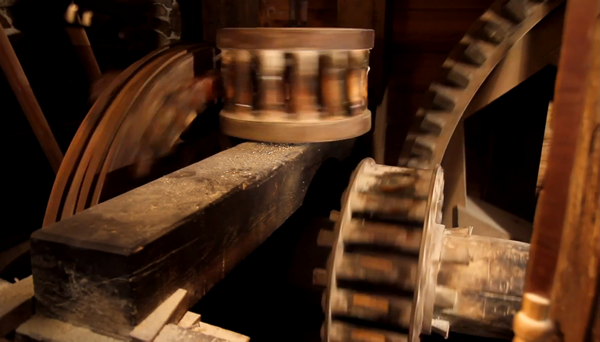
The surviving wooden power train in this mill is extremely are and is part of what makes the Mill at Anselma a national treasure. No original component of the drive train has survived, probably due to normal wear and tear. However, the technology has survived – the drive train is laid out and functions as it did when it was first build in 1747. The Mill has been designated a National Historic Landmark for the integrity of its power train.

In most mills, older technologies were usually completely dismantled and replaced as new technologies developed. At the Mill at Anselma, its milers upgraded system components and adapted newer technologies as they became available, but kept the original power train.

Each step of the milling process took place on a different floor. The miller or his apprentice would have to haul the grain between each process.

Technological Improvements

In 1785, an American inventor by the name of Oliver Evans, from Wilmington, Delaware, introduced the concept of continuous production to the milling industry. Anselma’s millers introduced his assembly line concept to the mill by the introduction of various labor saving devices that improved the productivity of the milling process.

Elevators moved the grain from floor to floor as it went through the milling process 

A Grain Cleaner or “Scourer” was installed  in the early 1800s. Before wheat could be ground, the miller would run it through a grain cleaner to remove the chaff, straw, dust and other unwanted substances.

Also in the early 1800s, a Bolter, which acts as a large sifter, was installed on the main floor. The Bolter was used to separate the flour from the middlings and offals (flour, middlings and offals make up wheat) after the grinding process. It contains a revolving cylindrical wheel covered with a silk fabric.

The Mill Stones

There are two stones used in any grinding operation: the fixed Bed or lower stone, on which rested the grain while a revolving Runner or upper stone performed the grinding.


There are three stands of stones at Anselma, two French Buhr Stones, used to grind flour and one made from native quarried stones, used to grind corn. 


The French Buhr Stones are made up of shaped blocks of freshwater quartz quarried in the Paris Basin, in France. It is not clear when they were last used at the mill. The stones were “opened” in January 2004 and oats were found between them.  Oliver Collins’ son Jack Collins said that his father had tried to use that set of stones to grind oats, but they did not feed properly, so he did not use them very long.


The native quarried stones were installed in the 1920s, by Oliver Collins, after the existing bedstone broke in half. It was used mostly for grinding corn for cattle feed but also ground wheat, rye, barley and oats. It weighs 3200 pounds and was quarried in Tucker Hill, Virginia.

Collins ground up to 4 tons of feed in an 8-hour day. The hopper is where the grain was poured to enter the millstones to be ground.

The damsel would agitate, allowing the grain to fall into the millstones in an even flow.

Dressing the Stones

Dressing refers to the process by which the millstones are sharpened by roughing up the stones. Grooves in the stones, called furrows would wear down from constant use.

Dressing would be done by either the miller himself or by a professional dresser. A dresser would travel from mill to mill. During this process, pieces of steel would become buried under the dresser’s skin. Dressers were often asked to “show their mettle”, the amount of steel imbedded in their hands and arms, which read like a resume for their dressing experience.

Oliver Collins referred to dressing the stones as the miller’s most difficult problem. The stones would be dressed twice a year and would take about a week and a half to complete. Horace Collins started his chore of dressing the stones when he was eleven years old.


© 2004 The Mill at Anselma Preservation and  Educational Trust  
1730 Conestoga Road - P.O. Box 42 -Chester Springs, PA 19425  
Tel: 610-827-1906 - Fax: 610-827-7345 - Email: info@anselmamill.org